Posts

The friendly twins!

Image

Mating!

Image
With some fear and trepidation we introduced our two VERY small males to the VERY large female, and of course nature provided all our fears unnecessary and within 30 minutes they were all in a big tangle and mating was going on. Snakes have to be together for a long time: the females only ovulate after mating has started, and they still have to be fertilised after that, so we are leaving these guys together for the next 3 - 4 weeks. If this is successful she will be pregnant for 9 months, so we have a long time to wait, but I hope we are at least on the way to our first breeding programme. On first introduction the two small males stuck closely together. Candoia bibroni bibroni apparantly like to mate with more than one male if possible. These two are siblings from the same litter, so the genetics should be the same whichever one is sucessful. One of the males explores the huge female Tangled tails hopefully mean mission accomplished - or at least underway After mating she retired to ...

Huge female ready to breed

Image
After nursing our small males from new-borns to over 1 metre long and 4 years old, we want to start a breeding programme. Females get much larger than males, so we knew our under 1 metre female wasn't ready yet... So Thomasina has come to stay! She belongs to a friend of ours who has been getting her into superb shape for the past 12 months, and now we think (hope) the time is right to introduce them. I'm a bit worried about the size disparity, but the experts tell us this is the way it works, so here we go.... Thomasina is twice as long and probably 4 times as heavy as Rifraf and Magenta, so either they are in for the time of their lives, or a completely traumatic experience. We'll keep recording! Here's the gorgeous Thomasina, almost 2 metres long: In her bath before joining our snake tanks: She's ready for her close-up Mr DeMille.... And our comparatively puny males, Magenta and Rifraf, hopefully up to the task....

Peter's lost snake returns!

Image
Just to prove that good things happen to he who waits... This small male Fiji Boa escaped his tank over a year ago, and was thought lost. Then a month ago a small head was seen peering out of the rafters, and he was recaptured none the worse for wear. The advantages of keeping snakes in their natural environment! His young owner is very happy to have him back, and he has settled straight back into his enclosure, probably very happy not to have to keep an eye out for mongooses the whole time anymore!

Alfie's New Baby

Image
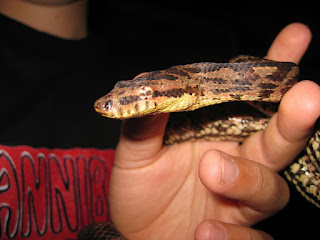
Here is a new addition, a small male Fiji Boa passed along from one 9 year old keeper to Alfie, our friend's son, who is just entering the wonderful world of snake keeping. He has unusually dark back markings and a really unique striped belly that I haven't seen before on any of the Fiji snakes. He's from a different Fijian island than our other snakes, so maybe this is the start of species diversification. He's also got some damage to his mouth: he's had this for more than 2 years and it doesn't seem to change or bother him, but it does give him a rather rakish expression.

RifRaf sheds again and this time it's HUGE!

Image
RifRaf sheds again and this time it's HUGE! We are always impressed when we get a full shed, more often it's in 2 parts. We keep the intact ones to compare growth rate. Shed skins are always larger than the actual snake. Rifraf is now 4 years old, and is just over a metre long, but this shed was more like 1m 20cm.

Fiji Snake's Smorgasboard

Image
Fiji Snake's Smorgasboard Fiji Boas in the wild feed on geckos and other small reptiles when young, and move on to rodents, birds and fruit bats when older. We don't have a reliable source of rodents, so we looked for other ways to supplement their diets now that they are outgrowing the geckos we catch around the house. They start feeding by taking a gecko or two, and then we follow up as they are just finishing the gecko with a chicken heart or pieces of chicken breast. Since we have started doing this they are putting on weight much more quickly than on geckos alone. Gecko's (MOKO), chicken hearts and chicken breast!

Kadavu colouring

Image
Colouring on a wild Kadavu snake. We're seeing different patterns and colours on snakes from different Fijian Islands. Our own pets are from the island of Taveuni and have distinctive zig-zag and diamond-back patterns. This snake is from Kadavu Island and is more irregulalry blotched (and quite pink).